What Is VVS Moissanite?
First found inside a meteorite, now grown in a lab and set by hand, VVS moissanite is the most brilliant gemstone on Earth — and the soul of every watch we build. Welcome to the science of the ice.
9.25
Mohs Hardness
Second only to diamond — built for a lifetime of daily wear.
0.104
Fire Dispersion
More than double a diamond's fire (0.044).
2.65
Refractive Index
Bends more light than diamond (2.42) — pure brilliance.
VVS1
Our Clarity Grade
Flawless to the naked eye — we accept nothing less.
A Gem Born From the Stars
Moissanite is a naturally occurring silicon carbide crystal, first identified in 1893 inside a meteorite that fell in Arizona. Because nature makes it almost impossibly rare, the stones we set are grown in a lab — the same crystal, the same chemistry, recreated molecule for molecule, without mining a single gram of earth.
What sets it apart is light. With a refractive index of 2.65 and a fire dispersion of 0.104, moissanite bends white light more intensely than any other gem — more than a diamond, more than anything. The result is a brilliance that doesn't just sparkle; it performs.
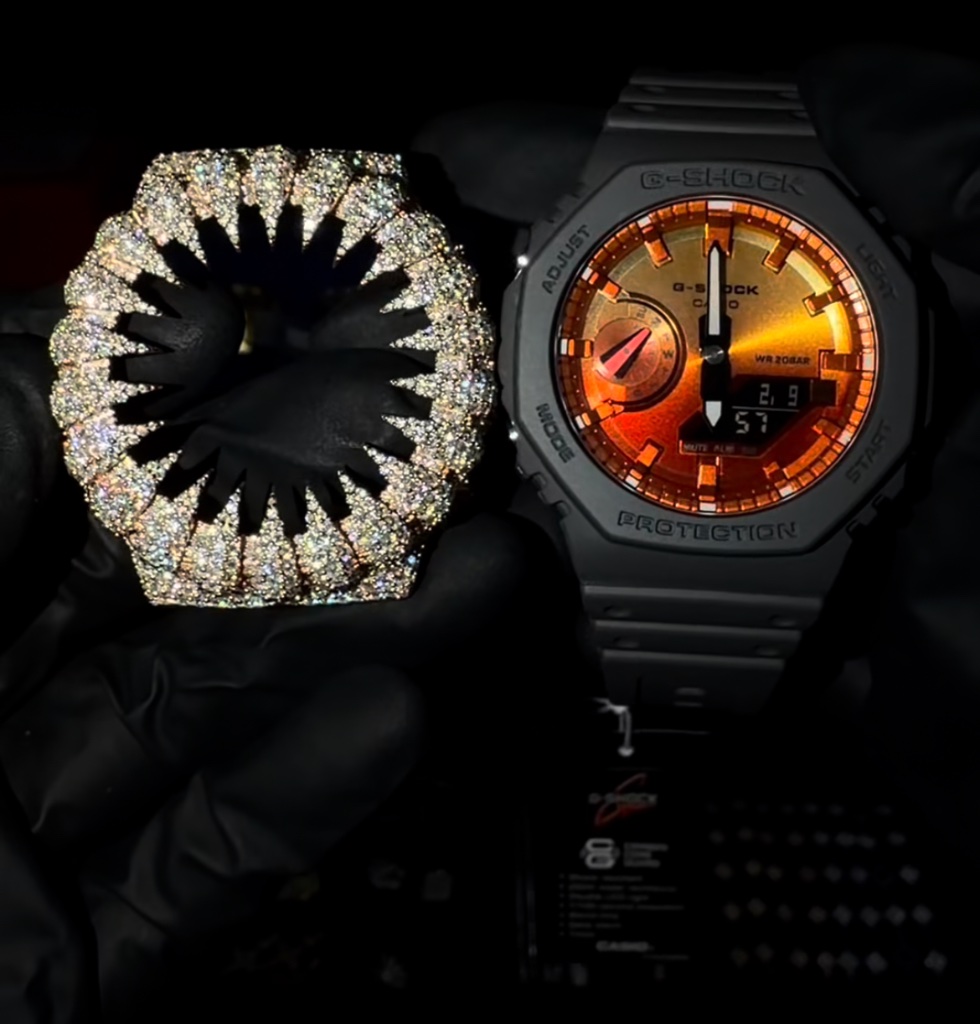
Yet it is nearly as tough as the stone it rivals. At 9.25 on the Mohs scale — just shy of diamond's 10 — it resists scratching, clouding, and time itself. We grade every stone to VVS clarity, accepting only those flawless to the naked eye, then hand-set each one onto a G-Shock platform built to outlast trends.
Moissanite vs. The Rest
Choose a property — see exactly how moissanite compares to diamond, by the numbers
Moissanite returns more white light to the eye — measurable brilliance.
| Property | VVS Moissanite | Diamond |
| Hardness (Mohs) | 9.25 | 10 |
| Fire (dispersion) | 0.104 | 0.044 |
| Brilliance (RI) | 2.65 | 2.42 |
| Origin | Lab-grown | Mined |
| Price | Accessible | Premium |